Your Customers Don't Want Another App
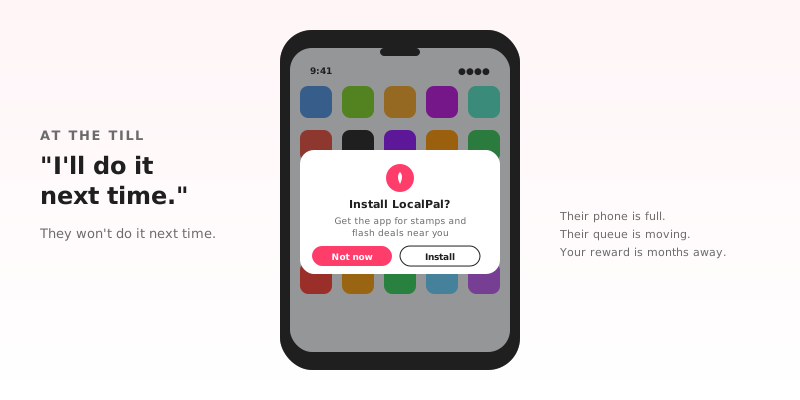
A scene that happens at tills across the UK every day, multiple times a day:
The customer pays. The owner says, "We're on LocalPal — would you like to join? There's an app you can download, or you can scan this QR code on the stand."
The customer's eyes flick to their phone. To the wall of app icons already there. To the time. To the queue behind them. They say, "I'll do it next time."
They will not do it next time.
The single biggest predictor of whether a loyalty programme works isn't the reward or the platform — it's how much friction your customer has to push through to get started. And in 2026, the highest single source of friction in that journey is the words "download our app."
This isn't a small problem. It's the difference between a loyalty list that compounds month-on-month and one that quietly dies in week three.
(If you'd rather see how LocalPal handles this, here's our merchants page.)
The phone is full
Most UK smartphones are crowded. Open the average customer's phone and you'll find dozens of apps — banking, weather, work, three different takeaway apps, a couple of social ones, the supermarket loyalty card they actually use, four they last opened a year ago. Storage is one issue; attention is the bigger one. Every new app is a new notification source, a new permissions dialog, a new password to remember.

When you ask a customer to download another app at the till, you're really asking them to:
- Take out their phone
- Open the App Store or Play Store
- Search for an app they've never heard of
- Read the permissions dialog
- Tap install and wait
- Open the app
- Sign up — usually with email and password
- Find your shop and add the card
That's eight friction points between hearing about LocalPal and being on it. Each step quietly leaks intended users — some leave at step 2, some at step 4, more at step 7. By step 8 you've lost most of the customers who said "I'd love to."
The customer who says "I'll do it next time" isn't being rude. They're doing what any reasonable person does when faced with eight steps to get a 5% discount on coffee in three months — they're deferring it indefinitely. The friction isn't the size of the reward; it's the eight steps.
What changed — and what shops missed
Five years ago, "download our app" was a reasonable ask. Loyalty programmes were novel, smartphones were still the new shiny thing, and customers were happy to install. Apps got downloaded.
The world is different now. Your customer's phone has banking, social, work, weather, takeaway, fitness, and three apps they haven't opened since the first hour. They've learned, in the meantime, that most apps want notifications, location, contacts, and — increasingly — a recurring subscription. The cost of installing one more has gone up.
The interest in loyalty hasn't gone away. Customers still want a free coffee after nine. What changed is the price of entry — and shops that haven't noticed are losing customers at the install step without ever knowing it. The customer doesn't tell you they didn't sign up because of the download. They just don't sign up.
What "appless" actually means
Appless loyalty means the customer can join your programme and earn rewards without downloading a dedicated loyalty app. There are three appless channels worth knowing about.
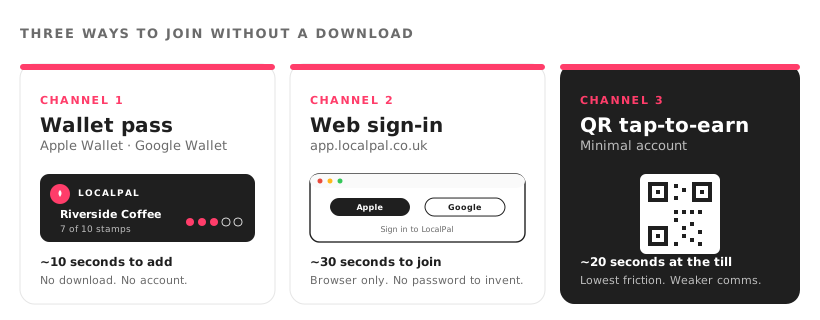
Apple Wallet and Google Wallet passes. Wallet apps are pre-installed on every iPhone and Android phone — every customer already has it. Your customer scans a QR code at the till and a loyalty card appears in their wallet, next to their boarding passes and credit cards, in about 10 seconds. No download. No account. The card updates as they earn stamps, and lock-screen notifications can fire when they're near your shop.
Web access via a browser. Your customer opens a URL, taps "sign in with Apple" or "sign in with Google," and they're on the loyalty programme. No download, no separate password to invent. This works particularly well for the customer who refuses both apps and wallet — they can run the whole loyalty experience through a browser tab.
QR-tap with minimal account. Some platforms let customers earn stamps purely by scanning a QR code at the till, with the card identified by an email or phone number. Even lower friction at the till than a full sign-up, though it usually means weaker downstream comms (no push, no in-app discovery feed). Useful as a fallback for the truly app-resistant customer who isn't on wallet either.
The honest answer for most UK shops is to offer all of them — and let the customer pick. The customer who wants the app gets the app. The customer who wants the wallet pass gets the wallet pass. The customer who refuses everything gets the web. You get the customer on the list, whichever route they took.
Why most loyalty platforms don't offer this
If appless conversion is so much better than app-only, why doesn't every loyalty platform offer it?
Two reasons.
The first is that building it is harder. Maintaining a mobile app is one channel. Adding a web client is two. Adding Apple Wallet pass support is three. Adding Google Wallet pass support is four. Each surface has its own design language, its own constraints, and its own ongoing maintenance. Most platforms stop at one or two.
The second is more pointed: app-only platforms benefit from app-only. Every customer of every shop on the platform ends up with the platform's app on their phone. From the platform's perspective that's distribution. From your perspective as the shop owner it's friction — the friction is the customer's, not the platform's, and the platform doesn't feel it the way you do at the till.
Most UK loyalty platforms are app-only as a result. Customers download the platform's app, the app contains their loyalty cards, end of story. This was the standard model from roughly 2018 to 2024 and many platforms haven't moved on. Among the four UK loyalty platforms shop owners ask us about most often — MagicStamp, Embargo, Squid, and LocalPal — only LocalPal currently offers the full set of channels: native app and web and Apple Wallet and Google Wallet. The other three require the customer to download the platform's own app to participate. We wrote a deeper comparison of where each platform sits in MagicStamp, Embargo, Squid or LocalPal? UK Loyalty Apps Compared.
There are also wallet-first platforms in the UK (Perkstar, Loopy Loyalty) that offer wallet but skip the app entirely. That's a different trade-off — they get the low-friction wallet signup but lose the in-app discovery feed and push channel that a full platform offers. Neither pure-wallet nor pure-app is the right answer for most shops. The right answer is to offer both, plus the web, and let the customer pick.
The friction maths — eight steps versus one

You don't need detailed conversion data to see the shape. If you ask 100 customers to download an app at the till in a typical week, a significant share will drop off at each step — and the customers you keep are the ones who were going to come back anyway. If instead you offer the same 100 customers a 10-second wallet add or a 30-second web sign-in, far more of them stick.
The exact numbers depend on your customer base. A high-end café in Shoreditch full of tech-forward customers will have different friction than a Tuesday-afternoon barber in a small market town. But the direction is always the same: fewer steps means more customers actually use the programme. That's what shows up on your list a month later — and that's what determines whether the loyalty programme compounds or not.
For more on how loyalty cards in Apple and Google Wallet specifically affect adoption, see Loyalty App vs Apple Wallet: What Actually Works. For how stamps actually get on the card at the till, see NFC Loyalty Cards Explained.
Three counter-arguments worth taking seriously
"My loyal customers will download anything I ask them to." True for some of them. False for most. The customers who'd download anything for you are already coming back — they're not the audience this is aimed at. The audience this is aimed at is the marginal customer you haven't converted yet: the new face who'd happily collect stamps if it cost them 10 seconds, but won't if it costs them a download.
"My customers are older, less tech-savvy, or don't use Apple Wallet." If that's true, the web fallback still exists. They sign in via browser — no download, no wallet. The point isn't "everyone uses wallet"; it's "give people the option that fits them." The same multi-channel argument applies in reverse: don't force any single channel on customers who don't want it.
"Multi-channel sounds complicated to manage." It sounds complicated. In practice it isn't. A platform that offers multi-channel handles the channel complexity on their end. From your perspective at the till, the customer either taps their phone, scans a QR code, or shows a wallet pass — and a stamp lands on the right card. You don't need to know which channel they used; the merchant dashboard shows you one customer record per customer, however they joined.
How LocalPal handles all of this
-
No download required to start. Web sign-up via Apple or Google in 60 seconds. The customer can be earning their first stamp before their drink is ready.
-
Apple Wallet and Google Wallet passes. Added from the website in about 10 seconds. No account creation needed.
-
The native app, if they want it. Push notifications, flash-deal discovery, full feature set. For the customers who do download apps — and a meaningful share still do.
-
One customer record per customer. Whichever surface they used to join, the merchant dashboard sees one person. Stamps earned via wallet, web, or app are interchangeable.
-
£25 a month, flat. Multi-channel isn't a premium tier — it's just the price.
Set up your shop on LocalPal — same-day onboarding for the loyalty programme. Or message us on WhatsApp at +44 7564 210401 if you'd like to talk it through first.
If your loyalty programme is leaking customers at the install step and you didn't know it, the simplest fix isn't a bigger reward — it's a smaller ask. Start here.